 Chat cu Clara AI

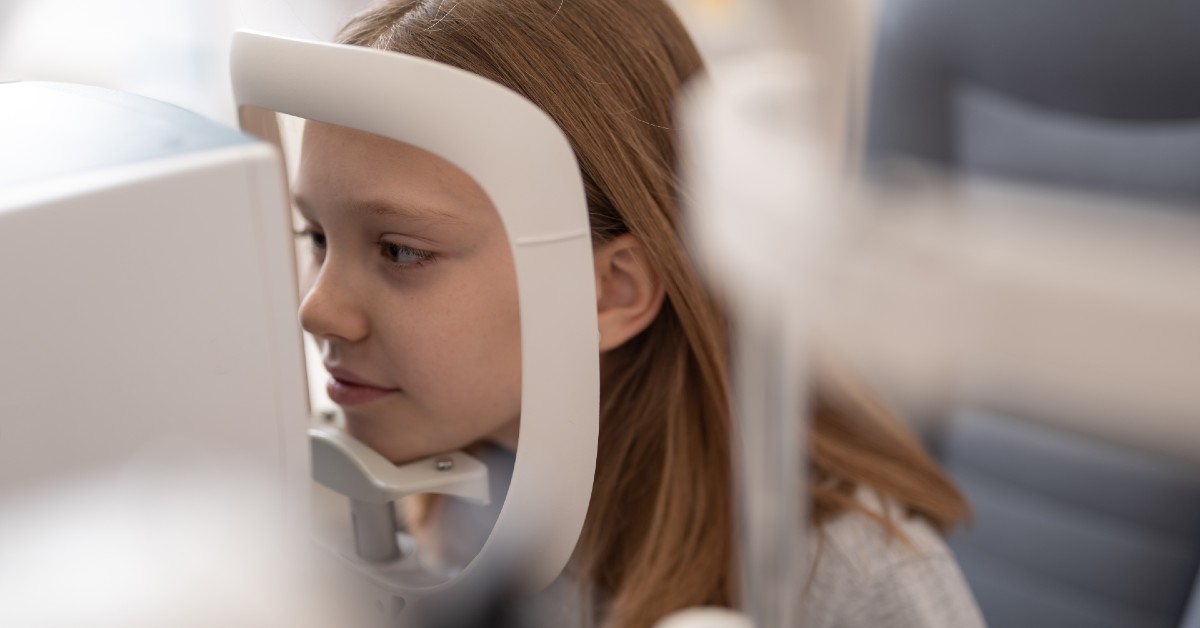
An ophthalmologic screening in children is recommended from the first months of life, to monitor vision development and to correct or diagnose early any possible vision problems. A first screening is recommended at 6 months, the next at 1 year, then at 3 years and later, at 5 years, before starting school.
Visual System Development in Newborns
The visual system is not fully developed at birth, so a newborn is not capable of seeing as clearly as an adult, perceiving more lights and shadows.
At birth, the child reacts to light, blinks, makes various facial expressions.
In the first month of life, the child begins to have visual contact, but at this age, eye movements are not coordinated. We can even observe some intermittent eye deviations that should disappear in the following months.
Between the 2nd and 3rd month of life, the baby's vision marks important progress. The eyes begin to move in coordination, and visual acuity increases. Children begin to follow objects and people around them and to analyze their little hands. Also during this period they begin to shift their gaze from one object to another without moving their head as they did in the first month of life.
The baby, at 6 months of age can carefully analyze toys, binocular vision and spatial vision developing further.
At What Age Is a First Ophthalmologic Screening Recommended in Children?
In the case of a prematurely born child (before 32 weeks and weighing less than 1500 g), the first ophthalmologic consultation is done in the maternity ward and then one month postpartum.
This is because treatment of retinopathy of prematurity is successful only if the diagnosis is made in time. If retinal detachment occurs, no surgical intervention leads to a good visual prognosis.
A healthy baby, born at term, should benefit from ophthalmologic screening in the 6-12 month interval of life.
On the other hand, if any warning sign appears, an emergency ophthalmologic consultation is indicated:
- the child has a more watery eye
- closes one eye in the sun
- a difference in size of the eyeballs is observed (could be congenital glaucoma)
- the eyes are not straight (one eye deviates)
- palpebral fissure asymmetries - the child doesn't open the eyes equally
- a white pupil.
Congenital glaucoma, if not diagnosed and treated in time, leads to irreversible vision loss. It is caused by abnormal development of the drainage system for fluid inside the eyes (aqueous humor) resulting in increased intraocular pressure with optic nerve damage. To avoid such a scenario, a pediatric ophthalmology specialist can examine the child at any age, even in the first weeks of life.
Why Is Ophthalmologic Screening Necessary in Children and What Vision Defects Can Appear in the First Years of Life?
Amblyopia is a unilateral and more rarely bilateral decrease in visual acuity, even with the best optical correction. It is an acquired condition that develops in the first months of life if there are favoring factors. If a sufficiently clear image doesn't travel from the eyes to the brain in the first months of life, the brain doesn't have the chance to learn how to correctly process visual information and to develop normally.
What Are the Factors Favoring Amblyopia?
Strabismus - Lack of parallelism of the eyeballs. It can be present from birth, intermittent, divergent (physiological strabismus). If it persists after 6 months of age, is permanent, the deviation is large, more frequently convergent – in this case it requires pediatric ophthalmologic evaluation and early treatment. Strabismus operated on in time leads to restoration of binocular vision and stereoscopic vision. Strabismus can hide other eye conditions (congenital cataract, tumors, retinal and optic nerve conditions).
Congenital cataract - The appearance of cataract at birth or in the first years has important consequences on vision development. The opaque lens prevents adequate transmission of visual stimulus to the retina, optic nerve and visual cortex, leading to reduced visual acuity, difficult to recover in the absence of appropriate, early treatment.
Palpebral ptosis covering the visual axis - Has high risk of amblyopia. The child tries to compensate for the deficit by contracting the frontal muscle (raises the eyebrow), raises the chin, tilts the head back. Treatment – in the first year of life, as soon as possible.
Refractive errors - Both eyes with high diopters. A large difference in diopters between the two eyes – anisometropic amblyopia.
Early detection of amblyopia and prompt initiation of treatment can lead to complete recovery of vision.
Don't hesitate to schedule an ophthalmologic screening for children in the first 1-2 years of life, because it can make a major difference in their quality of life!
Dr. Monica Apostolescu, Primary Ophthalmologist, Clario
