
What is Myopia?
Our eye is an optical system. Light enters through the front of the eye and, for us to see well, the image has to land at the back, on the retina. In myopia, the eye is usually a bit longer than it should be, so the image forms in front of the retina, not on it. In practice, the image that reaches the retina is blurry: up close we see well, at a distance everything gets hazy.
So what do we do to see clearly? We place a lens in front of the eye, a pair of glasses, and we move the focal point from in front of the retina back onto the retina. That is, in essence, the whole story of correction. Myopia usually appears in childhood, grows along with the eye until somewhere after the age of 20, and is corrected with glasses, with contact lenses or, permanently, through laser surgery.

What Are the Causes of Myopia?
The most common is inherited myopia. We often see it in families where one or both parents are myopic themselves. It usually starts in early childhood or in the first school years.
Myopia can also be associated with genetic syndromes or metabolic disorders. This is a progressive form, which often reaches high values and comes with changes in the retina, which is why these children need closer monitoring.
There is also myopia driven by environmental factors. Intense, prolonged near work overworks the muscle inside the eye that handles focusing. Long hours on the phone, tablet or laptop and reading in poor light can lead to the onset and progression of myopia, sometimes even after the age of 20.
Congenital myopia is present from birth. Premature babies are the most affected, as they can develop a degree of retinopathy of prematurity.
Why Do Diopters Increase?
Patients often ask me whether diopters grow because "the glasses are too strong" or because "the eye gets used to the glasses". No, these are myths. Diopters increase as the eye elongates, and that is part of the natural growth process of a child. What speeds things up: prolonged near work, too little time spent outdoors and genetic inheritance. In adults, if diopters that have been stable for years suddenly start to climb, we take a closer look, because this can signal other eye conditions.
How is Myopia Classified?
We classify myopia according to the diopter value:
- low myopia (under 3 diopters)
- moderate myopia (between 3 and 6 diopters)
- high myopia (between 6 and 10 diopters)
- severe myopia (over 10 diopters)
Severe Myopia (Over 10 Diopters)
Severe myopia is a category of its own. It starts early, from birth or the first years of life, and evolves progressively, sometimes going past 30 diopters. Here we are talking about an eye much larger than it should be, with stretched, more fragile structures. I am not saying this to scare anyone, but to make it clear why these patients need regular retina check-ups. For severe myopia, laser correction is usually no longer possible; the surgical solution is, as a rule, lens replacement.
Of all the forms of myopia, the one we meet most often is the so-called "school myopia". It shows up around the age of 6–7 and progresses until somewhere around 20, usually without going past 6 diopters and without producing changes in the fundus of the eye. Growth is steepest between 8 and 12 years, but it does not stop for good after that.
This myopia goes hand in hand with the child's development: as the body grows, the eye grows too, so the diopters may climb a little further.
Symptoms of Myopia
The first sign is almost always the same: blurry distance vision. To compensate, myopic people squint, trying to see more clearly.
In children, parents usually notice that they:
- cannot see clearly what is written on the blackboard;
- squint and rub their eyes often;
- move closer to the TV, the phone or the notebook.
In adults, the common signs are:
- headaches and eye strain after near work;
- difficulty seeing at night, especially when driving;
- towards the evening: headaches, dizziness, light sensitivity.
How is Myopia Diagnosed?
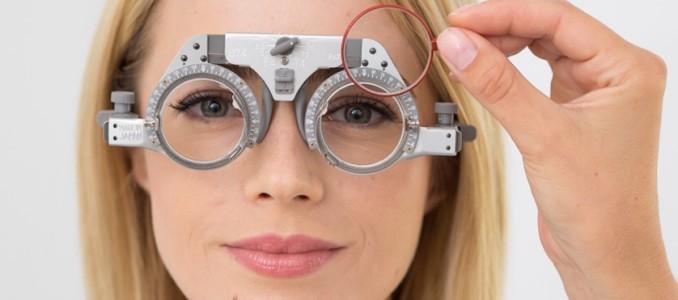
The diagnosis is made during the ophthalmological consultation. First we test visual acuity, to see how much the vision is affected, then we measure the diopters with a dedicated device, the autorefractometer.
In children and young people, for a correct measurement, we first instill cycloplegic drops. Their role is to fully relax the muscles inside the eye, which otherwise "cheat" during the measurement. Without these drops, correction errors can appear, meaning the wrong glasses.
The consultation with dilated pupils also lets us see inside the eye: the retina, the optic nerve. We have to measure the diopters correctly and check that there are no other associated conditions. It is a serious matter, even if for the patient it only means a few hours of blurry vision.
How is Myopia Progression Monitored?
Once myopia has set in, it does not regress. On the contrary, it can grow as the eye grows. That is why we monitor it instead of leaving it to its own devices.
For Children with Myopia
Children with myopia who wear glasses or contact lenses come in for a check-up every 6 months. We follow the evolution of the diopters and adjust the correction, so that vision stays good at all times. One thing I keep repeating to parents: we do not under-correct. "Weaker glasses, so the eye doesn't get used to them" not only do not help, they actually speed up myopia progression.
Besides the diopters, in these children we also periodically measure the length of the eye, the antero-posterior axis, which shows us exactly how fast things are evolving.
For Adults with Myopia
For adults with stabilized diopters, one check-up a year is enough. We verify the diopters and look at the fundus of the eye, to catch in time any retinal problems or other conditions that can come with myopia, such as glaucoma and cataract.
When Does Myopia Stabilize?
Usually, myopia settles somewhere after the age of 20, give or take, once the growth period ends. "School myopia" climbs fastest between 8 and 12 years and gradually slows down after adolescence. Stabilization is not guaranteed, though: intense near work can push the diopters up even later. For laser surgery, we want the patient to have stable diopters for a year, a year and a half, maybe even two.
How We Slow Down Myopia Progression in Children
What can we do so that a child's myopia does not grow at a gallop? Quite a lot, actually. Myopia cannot be cured, but its progression can be slowed down significantly, by up to 60%, if we step in early. The earlier myopia starts and the faster it grows, the higher the risk of high myopia in adulthood. The methods we work with today:
- Time spent outdoors, at least 2 hours a day, in natural light. It is the simplest measure and, perhaps surprisingly, one of the most effective.
- Spectacle lenses with peripheral defocus (MiYOSMART 2). They look like regular glasses, but the special lens design slows myopia progression by up to 60%. They can be worn from the age of 6 and are available at the Clario medical optics.
- Orthokeratology, the night lens. A rigid lens worn during sleep, which temporarily reshapes the cornea: the child sees clearly during the day, without glasses, and myopia progression drops by 40–50%. We usually recommend it from 8–10 years. Here is our in-depth guide to the night lens.
- Low-dose atropine (0.01%). Drops given in the evening, which slow down the elongation of the eye. The treatment is done only on the recommendation and under the monitoring of the ophthalmologist.
- Full optical correction. I said it above, but it bears repeating: under-correction speeds progression up, it does not slow it down.
At Clario we run a dedicated myopia control program for children: we see children with progressive myopia every 6 months, with cycloplegic diopter measurement and eye axis measurement. For a complete evaluation, the first step is a pediatric ophthalmology consultation.
Complications of Myopia
I want to be clear here, without scaring anyone: low and moderate myopia are usually not accompanied by other eye problems. Above 5–6 diopters, complications can appear, and their frequency grows with the diopters. An eye with high diopters is a larger eye, with stretched, thinned, more fragile structures.
Retinal changes may appear (myopic choroidosis, Fuchs spot, retinal tears or retinal detachment), scleral changes, retinal hemorrhages or neovascular membranes. All of them have specific treatment: laser, intraocular injections or surgery. The key is catching them in time, at the periodic check-ups.
Myopia can also be associated with the earlier onset of open-angle glaucoma, which is treated with drops, laser or surgery. Likewise, in myopic patients cataract sets in somewhat earlier; the good news is that cataract surgery significantly improves their vision.
To patients with high myopia we recommend avoiding intense physical effort, contact sports, jumping from heights and lifting heavy weights. In these situations, the fragile structures of the myopic eye can suffer sudden changes: retinal tears, vitreous disorders or retinal detachment.
Myopia and Pregnancy
Expectant mothers with myopia often ask me two things: whether their vision will get worse during pregnancy and whether they can give birth naturally. To the first question: diopters can increase temporarily, because of the hormonal changes. That is why changing glasses or having an evaluation for laser surgery is usually done a few months after birth, once the values settle.
To the second question, the honest answer is: it depends on the retina, not on the diopters. Myopia, even with high values, does not automatically rule out natural birth. What we do in practice: during pregnancy, the patient with myopia, especially above 5–6 diopters, comes in for a consultation with a fundus examination. If we find risky retinal lesions, we can treat them preventively with laser, and the final recommendation for birth is established together with the obstetrician.
Can Myopia Be Cured?
This is probably the question I hear most often. The honest answer: no, myopia cannot be cured. Glasses and contact lenses correct vision while they are worn, without changing anything about the eye. Laser surgery permanently removes the existing diopters, so you do get rid of glasses, but the eye remains a myopic eye in its structure, with the same particularities. That is why periodic retina check-ups remain important even after surgery. And in children, progression can be seriously slowed down through the myopia control methods we talked about above.
How is Myopia Treated?
Myopia is an optical defect of the eye, and treatment means, in most cases, correcting the vision, not correcting the myopia itself. We have several options, each with its place.
Optical Correction
The most used method remains optical correction: glasses or contact lenses. Most often we prescribe glasses with divergent lenses, the "minus" lenses. Our rule: the lowest lens value that gives the best vision.
Contact Lenses
Another option is soft contact lenses, with daily or monthly wear. Their advantages: the visual field is much wider than with glasses, and sports become much simpler. They are also useful when there are large diopter differences between the two eyes, because they are better tolerated than glasses in this situation. The essential condition: rigorous hygiene, to avoid complications.
The Night Lens
A modern option is the "night" contact lens, a rigid lens that goes on at bedtime and comes off in the morning. Worn during sleep, it gently flattens the cornea, and during the day the patient sees well without any glasses. In children it has the bonus of slowing down myopia progression. Here too, lens care and periodic check-ups are not negotiable.
Laser Surgery for Diopter Reduction
For those who no longer want to depend on glasses or lenses, there is laser diopter reduction surgery. The laser reshapes the cornea, the lens at the front of the eye, finely "polishing" it and removing the diopters. It is a procedure on the surface of the eye, not an intraocular one, and complications are very rare.
I have patients who imagine they just pop their head through the door and the laser surgery happens on the spot. Not quite. Before surgery we run a series of detailed measurements, precisely to see whether the eye is suited for this type of procedure. The lasers we work with are sophisticated machines, which I am genuinely fond of, but they give good results only on a correctly evaluated eye.
Laser Surgeries, in Short
PRESBYOND Laser Blended Vision is the most advanced ZEISS laser procedure, the only one that corrects presbyopia, the near-vision difficulty appearing after the age of 40, as well as the other pre-existing refractive errors.
SMILE PRO is the third generation of laser procedures for correcting myopia and/or myopic astigmatism. It is considered the least invasive and is performed in a single step, with the ZEISS VISUMAX 800 femtolaser.
Femto LASIK is the second generation of laser procedures and the most used worldwide, thanks to its versatility. It corrects myopia, hyperopia and/or astigmatism and uses two types of lasers: femtosecond and excimer.
PRK is the first generation of refractive surgery, in which the laser polishes the surface of the cornea directly. We use it for low myopia or for people with a thin cornea.
The surgery itself is painless, takes a few minutes, and recovery is fast: somewhere within two or three days the patient usually returns to their normal activities. That does not necessarily mean sitting 12 hours in front of the computer the next day, but it is not forbidden either.
When Do We Replace the Crystalline Lens, and When Do We Keep It?
The crystalline lens is the lens inside the eye. It is a living, very elastic lens, which changes its shape depending on the distance we look at, and that is why, when we are young, we see well at all distances. I tell my patients one simple thing: as long as this lens is clear and doing its job, we leave it where it is. We do not remove a healthy structure of the eye.
So what do we do about the diopters? In the vast majority of cases we correct them with laser, on the cornea, at the surface of the eye, as shown above. Lens replacement remains for the situations where it truly makes sense: when the diopters are too high for laser or the cornea is too thin, when the lens has already started to cloud, meaning cataract is setting in and we would have reached this surgery in a few years anyway, or past the age when the lens no longer focuses up close anyway, usually after 40-something, give or take.
Patients often ask me what the surgery is like. I tell them it is like putting your glasses inside your eye: we remove the lens that no longer works properly and put in its place one measured precisely for that eye. And the artificial lens does not age. Sometimes, a while after surgery, the capsule holding the implant can become hazy, but that is solved simply, with laser, in one short session.
Important: both after laser surgery and after lens replacement, the optical defect is gone, but the eye remains a myopic eye in its structure, with its more fragile parts and the same risks as before surgery. The recommendations to avoid intense physical effort, contact sports and blows to the head remain valid.
What we choose in the end is not a matter of preference. We take the measurements, we see what the eye looks like, and only then do we recommend the option suited to each patient's age and needs. It is a serious matter, and that is why the preoperative evaluation matters so much.
How Much Does Myopia Correction Cost?
The final, natural question. At Clario, for permanent diopter reduction, the costs look like this:
- Evaluation consultation for surgery: 500 lei
- Preoperative investigations: 700 lei (one eye) / 1,000 lei (both eyes)
- SMILE PRO, Femto LASIK or PRK surgery: 7,900 lei/eye, with postoperative check-ups at one day and one week included
- Lens replacement (for very high myopia or thin cornea): 9,800 lei/eye
The complete list is on the prices page, and we covered the whole journey in detail in the laser diopter reduction guide.
Frequently Asked Questions
Myopia is a refractive error in which the image forms in front of the retina, not on it: up close we see well, at a distance we see blurry. The myopic eye is usually a larger, more elongated eye.
No. Glasses and contact lenses correct vision while they are worn, without changing the eye. Laser surgery permanently removes the existing diopters, but the structure of the eye stays the same, which is why periodic retina check-ups remain necessary.
Diopters increase as the eye elongates, a process tied to the growth of the body in children and teenagers. Prolonged near work and genetic inheritance speed up progression. Correctly prescribed glasses do not increase diopters.
Usually, myopia settles somewhere after the age of 20, once the body stops growing. For laser surgery, we want the diopters to be stable for a year, a year and a half, maybe even two.
Severe myopia is the most advanced form, with values above 10 diopters, early onset and progressive evolution. These patients need periodic retina check-ups, because the risk of complications grows with the diopter value.
There is no medication that removes myopia. In children, low-dose atropine (0.01%) can slow down myopia progression, as part of a myopia control program initiated and monitored by the ophthalmologist.
In patients with high values, complications may occur: retinal changes (myopic choroidosis, Fuchs spot, retinal detachment), open-angle glaucoma, early cataract. This is why we recommend periodic retina check-ups for high myopia.
SMILE PRO, Femto LASIK and PRK, laser procedures that reshape the cornea. For very high myopia or a thin cornea, lens replacement is recommended. The right method is established after the preoperative investigations.
At Clario, the SMILE PRO, Femto LASIK and PRK laser procedures cost 7,900 lei per eye, with postoperative check-ups included. The evaluation consultation costs 500 lei and the preoperative investigations 700–1,000 lei.
Only when there is a real reason: diopters too high for laser, a cornea too thin, or a lens that has already started to cloud. A clear, functional lens stays where it is; the first option is usually laser correction, which does not go inside the eye.
The decision depends on the condition of the retina, not on the diopter value itself. An ophthalmological consultation with a fundus examination is needed during pregnancy; if the retina is healthy, myopia does not automatically rule out natural birth, and the final recommendation is established together with the obstetrician.

