 Chat cu Clara AI

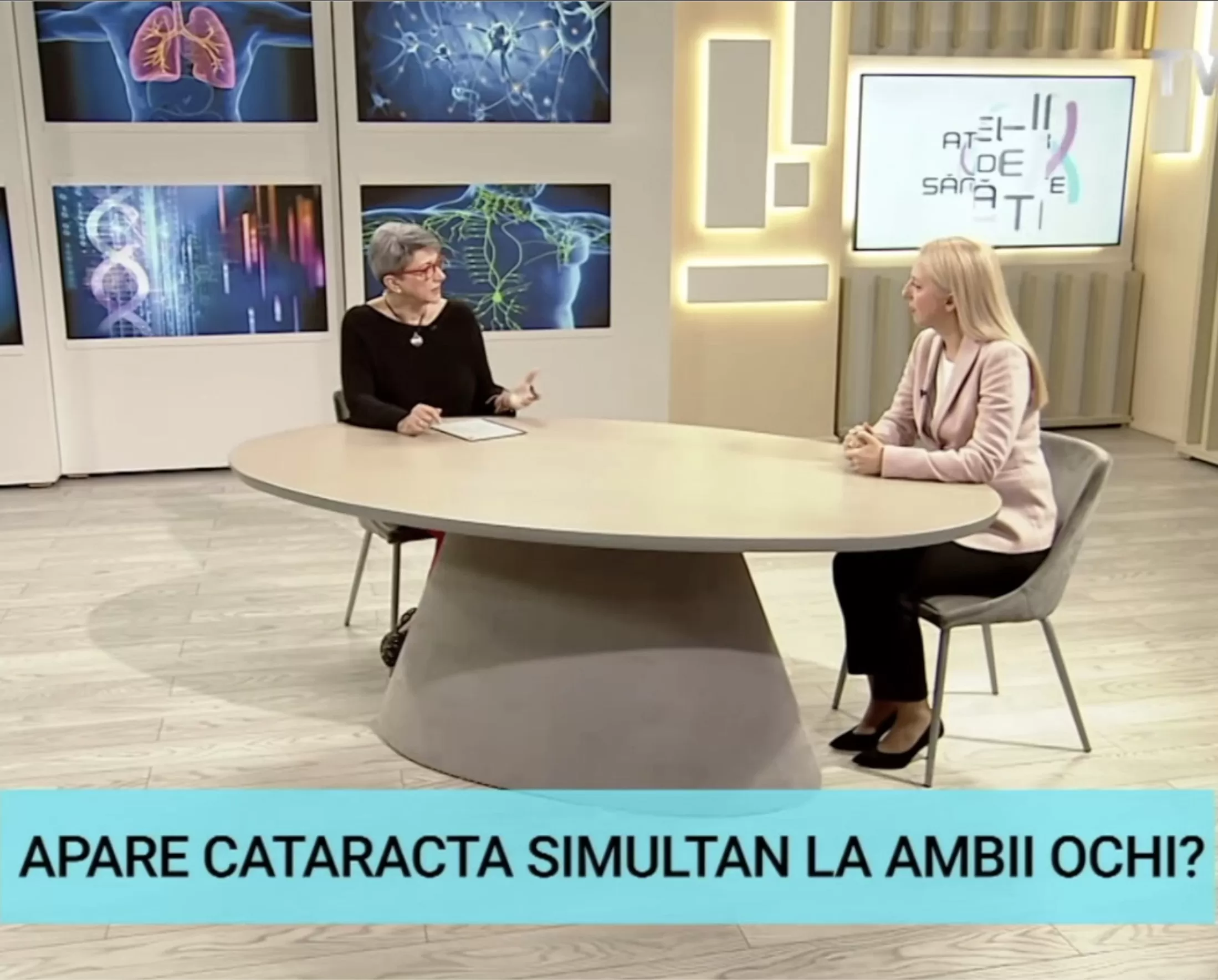
With us is Dr. Silvia Chiotoroiu, primary ophthalmologist, doctor of medical sciences. Thank you for being with us to discuss an important topic, as cataract affects between 70 and 100 million people.
Types of Cataract
– These are approximately the estimates of people worldwide and the majority of elderly people over 80 years old, right?
– Yes, from a statistical point of view, after age 65, more than 70 percent of the population will develop cataract. Now with increasing life expectancy, more and more people have this condition.
– That's what I wanted to ask you, because vision loss caused by cataract has increased by almost 30% from 2000 to 2020. Why is there such an increase? Only because of population aging?
– That is the main cause and there are less developed countries where the population does not have access to treatment, because this pathology is perfectly curable. That is, if there is no other eye condition, vision restoration after surgical intervention is complete.
– I saw that there are several types of cataract and in the previous material can you tell us more about the most common ones?
– The most common are senile cataracts. These are the most frequent. There are primary cataracts. As you mentioned, these can be congenital, which appear from birth and must be intervened immediately because they can lead to loss of eye functionality. Juvenile, presenile cataracts and most, as I said, are senile cataracts that appear after age 65 and secondary cataracts that appear, as was nicely said in the material, in another context. Secondary to ophthalmologic conditions, secondary to systemic diseases or treatments. So several types. For example, if you have diabetes that is not very well compensated, you can develop cataract much faster: At age 55, even faster and under 50 years old.
Cataract Symptoms
– You were talking about types of cataract. Let's now address the issue of symptoms. A series of symptoms were listed in the previous material. Which are the most bothersome and which are actually the ones that send the patient to the doctor?
– First of all, blurred distance vision. This is the first. It is the main symptom. The patient no longer sees well at distance and paradoxically, an improvement in near visual acuity appears. They are even happy that they no longer need reading glasses. But this is only a transitional period. Then vision collapses and they no longer see either at distance or near. Night vision decreases, halos appear around light sources. Photophobia may appear, a decrease in color intensity. Colors are much paler and the patient can no longer carry out normal activity, can no longer drive at night, no longer sees the TV, has a discomfort that brings them to the doctor.
– Does cataract always appear in both eyes, simultaneously, one at a time?
– Cataract progresses bilaterally but not symmetrically, not in the same proportion. One eye is always more affected and the other less affected. There are risk factors.
– Are there things we do through our lifestyle, through our professional activity, let's say, that expose us more to this condition?
– Well, for example, if we stay more in the sun and don't use glasses with UV protection, we can develop cataract faster. There would also be radiation exposure, chemotherapy treatment, long-term cortisone treatment, amiodarone treatment. There are several factors that can lead to cataract development, but in most cases, cataract is an age-related disease.
– So, like it or not, at some point, most of us will suffer from cataract.
– If we reach age 90-95, we will all develop cataract.
Cataract Diagnosis
– How is it diagnosed? Since it is, we see, a given of nature, how is cataract diagnosed and what should the patient especially know before the examinations they will undergo?
– The diagnosis is established by the ophthalmologist. It is very important that the patient comes when they notice blurred vision, glasses no longer help and they can't manage then. You know, it's sometimes hard to realize if you don't accidentally cover one eye. To see that you don't see. Actually, as I said it progresses asymmetrically. And then, when the patient notices that they see poorly with one eye. And that this poor vision persists, they should come for an ophthalmologic consultation.
– What does the consultation consist of in case of cataract? That is, how is the diagnosis made? Is it simply the routine or usual ophthalmologic consultation?
– It is a complete ophthalmologic consultation, which includes measuring visual acuity, intraocular pressure, biomicroscopic examination with the slit lamp biomicroscope, fundus examination to rule out other pathologies that can cause decreased visual acuity. If the ophthalmologist, the specialist doctor makes the diagnosis of cataract, we move to the next stages, respectively to treatment. But before treatment we must establish the diopter value of the lens we are replacing. The artificial lens that replaces the natural lens is determined through an investigation called biometry: we measure the diopter value of the lens. Then we have a discussion with the patient and see according to their wishes and according to needs and according to possibilities, what kind of lens we recommend.
– In other words, by replacing the lens, other pre-existing vision problems are also corrected.
– Refractive errors are corrected. We can correct these. For example, if a patient was hyperopic, through diopter correction of the lens we can bring them to emmetropia. And for myopic patients, if for example they had high myopia, minus 10 diopters, we can bring them to lower myopia, minus two or even zero, but it is not recommended to leave myopic patients at 0 diopters, because they are used to seeing without glasses up close. It's a longer discussion with the patient.
– Let's explain more precisely for our viewers what hyperopia is.
– Hyperopia is a refractive error in which the eyeball is shorter than an emmetropic globe (emmetropic is the normal globe) and then the image is focused behind the retina. This refractive error is corrected with plus lenses. After 40 years, in addition to this plus, the reading diopter is also added. Myopic people have a longer axis, a longer eyeball and then the image is focused in front of the retina and to correct it, we wear minus lenses.
– This means that the patient, after cataract surgery, no longer wears glasses.
– If they opt for a monofocal lens, they will no longer wear distance glasses or, in case of myopia, they will wear smaller glasses at distance. If we opt for a multifocal lens, they won't wear glasses at all.
– That's good news and is, how to say, a factor that should stimulate patients to come to the doctor early. And here, they also have this benefit if they decide to choose such a lens.
– Yes, but it doesn't suit all patients, that is, if they have other conditions, besides cataract, such as glaucoma or retinal pathology, diabetic retinopathy, macular degeneration. Then these premium lenses are not recommended. They are recommended for patients who, apart from cataract, have no other conditions.
Surgical Treatment
– Treatment is surgical.
– Only surgery solves the problem.
– Are there innovations? Will there be, let's say, the promise of treatments in which surgical intervention is avoided?
– Not yet. Not yet. But...we hope.
– How does the actual intervention proceed and what should the patient know about their part of, let's say, responsibility in this intervention, how do they prepare for the intervention and what should they know about what happens postoperatively.
– It is very important after this consultation to establish what kind of lens we will put in. It is good to perform some routine tests, to see if they are compensated in terms of blood sugar, if they don't have other pathologies, coagulation disorders, that interfere with surgical intervention. We set the date when they will be operated. We present the anesthesia options, because this is also important: anesthesia is always local, it can be done with drops (topical) or parabulbar or retrobulbar, depending on the complexity of the surgical intervention. If it is a more advanced cataract or if we do a combined operation. For example, they have cataract and diabetic retinopathy and we want to also operate on the diabetes, then we do anesthesia that is long-lasting and we proceed to the actual interventions. Two incisions are made at the cornea level, which are very small in size 2.2 mm, respectively 1.2, or depends on the technique, two of 1.2 and the operation is done through the phacoemulsification technique with ultrasound. Many say about laser surgery. Yes, there is also laser in cataract surgery, but the laser does only two steps. Practically, it cuts the anterior capsule (capsulorhexis) and fragments the lens, which, if you don't have this laser, you do mechanically. And in the actual operation, lens emulsification is done with the ultrasound probe.
– How long does the intervention take?
– On average, between 10-12 minutes.
– A question because many patients are elderly. Do they need to be assisted by someone for a few days after the operation?
– Yes, it is good to be helped if they are very elderly. Now, doing this operation with drops, I recommend patients when they get home, after an hour, an hour and a half, to remove the bandage and start putting in the drops from the day of the operation itself. When they come the next day, they are already very satisfied with the surgical intervention and see much better, the results are immediate. There are two conditions: they shouldn't have other associated conditions, the operation should proceed normally, and the cataract shouldn't be very advanced, because the more advanced it is, the more ultrasound is used, and the cornea suffers. It suffers a transitory edema, corneal edema, which remits in a week, but the patient is a little dissatisfied.
– At the end of our discussion, doctor, because, here, it is very important not to reach the doctor when the disease is very advanced and the results of the intervention will depend on this. Let's say we are the average citizen, but at some age we started wearing reading glasses. How often should we have a complete ophthalmologic checkup, including all cataract-related examinations after 43 years?
– After 43 years we go to the doctor anyway because we don't see anymore, we start to move things away, we don't see up close anymore and we need glasses. Until age 50, every two years and after age 50, annually. If we have associated pathologies, such as diabetes, glaucoma, macular degeneration, then checkups are every six months and then we can detect in time. It is not good for cataract to be very advanced. It is good when 30-40% of vision is lost, practically vision is 70%, to think about an intervention. At 50% it is already very good to operate the cataract.
Frequently Asked Questions
On average, between 10-12 minutes.
Yes, by replacing the lens, refractive errors can be corrected. With a monofocal lens you won't wear distance glasses, with a multifocal lens you won't wear glasses at all.
Until age 50, every two years. After age 50, annually. If you have associated pathologies (diabetes, glaucoma), checkups are every six months.
