 Chat cu Clara AI

What is Age-Related Macular Degeneration?
Age-related macular degeneration (AMD) is a degenerative condition of the macula appearing predominantly from the age of 50. The macula is the portion of the retina responsible for central vision, making it possible to see details clearly. AMD can be viewed as part of the individual's aging process.
What are the Risk Factors Involved in AMD?
Associations have been found between AMD and heredity, smoking, hypertension, high cholesterol levels, and sedentary lifestyle.
How Does the Disease Progress?
There are two types of age-related macular degeneration:
1. AMD - Dry, Atrophic Form
This is the initial form of age-related macular degeneration; it is characterized by the appearance of drusen (accumulation of lipid material) which leads to retinal thinning and alteration of visual function. Visual acuity decreases gradually.
Signs and symptoms of the atrophic form:
- blurred vision at distance/near;
- need for additional light to see up close;
- colors are perceived as more "faded";
- difficulty/impossibility in recognizing people's faces;
- appearance of a black spot in the center of vision.
2. AMD - Exudative Form
Its characteristic is the appearance of a neovascular membrane (with abnormal blood vessels, through whose walls fluids, lipids, and blood leak - which deposit and eventually form a fibrovascular "scar" leading to irreversible vision loss).
Signs and symptoms of the exudative form:
- distorted vision - straight lines appear curved, irregular, interrupted;
- dark gray spots in the visual field;
- loss of central vision;
- alteration of perception of colors, shape and size of objects.
Symptoms usually worsen very rapidly.
How is the Disease Diagnosed?
The presence of drusen or the neovascular membrane is observed during an ophthalmologic consultation with fundus examination after administration of drops for pupil dilation. Paraclinical investigations performed for a definitive diagnosis are: optical coherence tomography (macular OCT), fluorescein angiography - both for diagnosing the presence of neovascular membrane.
Is There Treatment for AMD?
It is important to note that currently there is no specific treatment for curing AMD.
In AMD dry, atrophic form, a decrease in disease progression has been demonstrated by using nutritional supplements (vitamin C, vitamin E, lutein, zeaxanthin, zinc oxide + copper), a diet rich in antioxidants (blueberries, spinach, broccoli, fish), and by adopting a healthy lifestyle (moderate physical activity, balanced diet).
It is important to mention that only approximately 10% of macular degenerations are exudative forms, but also that approximately 75% of these cases cannot be treated. Patients who do not respond to treatment will NOT become completely blind, still having functional peripheral vision.
In AMD exudative form, the faster the presence of the neovascular membrane is discovered and treatment is initiated, the better the chances of preserving vision at a better level. Treatment options are: intraocular injections with substances that inhibit abnormal vessel growth, laser treatment, and photodynamic therapy.
Can it be Treated with Glasses?
Because vision is affected in AMD through retinal damage, and not through the existence of diopters, no glasses can improve vision lost through AMD (exceptions are situations where there are also associated refractive errors - myopia, hyperopia, astigmatism - in which glasses can only correct these errors). For patients who do not respond to the above-mentioned therapy and have extremely low vision, there are specific magnification devices that facilitate various activities.
Can it Lead to Blindness?
AMD can affect one or both eyes; the patient may come to the doctor late because the vision decrease in one eye can be masked by the unaffected eye. The progression can be slow or rapid, depending on the form of the disease. Never, AMD does not lead to complete vision loss. Usually, in advanced forms, patients retain peripheral vision that helps them navigate in space.
What Can Be Done to Prevent Progression to Severe Disease?
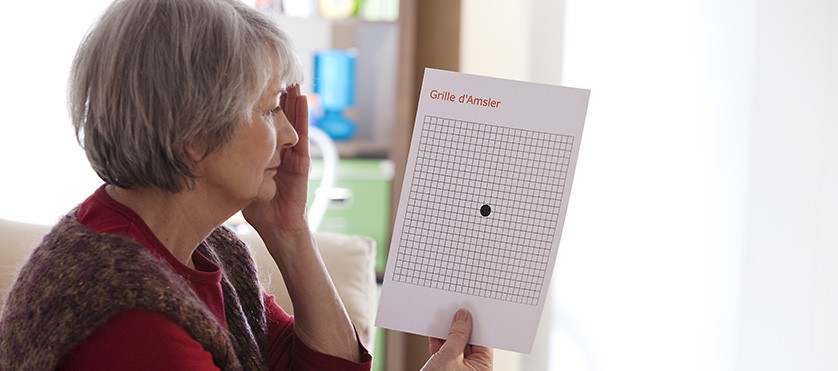
Patients diagnosed with AMD must permanently monitor their visual function, because the atrophic form can transition to the exudative form, with the appearance of neovascular membrane and dramatic vision loss. The Amsler grid is used for monitoring visual function.
Rules for using the Amsler grid: position the grid 30-40 cm from the patient; cover one eye at a time; the patient looks monocularly at the central black dot of the grid; while the patient looks at the central point, they must observe if all grid lines are straight, parallel, or if there are distortions, blurred or black areas (scotomas) in the visual field; repeat successively with the contralateral eye; if the patient notices any of the modifications listed above, they should see an ophthalmologist as soon as possible.
Also, a healthy lifestyle with moderate daily physical activity, a balanced diet (with lots of green vegetables, fish, blueberries, etc.) can increase the chances of good general health, also influencing eye health.
5 Important Things to Remember About AMD:
- AMD has no "loud" signs of appearance.
- Early diagnosis leads to a better prognosis.
- Risk increases with advancing age.
- Smoking increases the risk of AMD appearance and progression.
- Treatments do not cure, but slow disease progression.
Frequently Asked Questions
AMD is a degenerative condition of the macula appearing predominantly from the age of 50. The macula is the portion of the retina responsible for central vision.
Never, AMD does not lead to complete vision loss. In advanced forms, patients retain peripheral vision that helps them navigate in space.
There is no specific treatment for cure. For the dry form: nutritional supplements, diet rich in antioxidants. For the exudative form: intraocular injections, laser, photodynamic therapy.
