 Chat cu Clara AI

What is Presbyopia?
Presbyopia is a rather unpleasant phenomenon that all people notice around the age of 40. What happens? We find that, at the normal reading distance, we begin to see the letters in a haze and, to clarify the image, we move the book or newspaper further and further away. Eye or headaches may also appear after more intense close-up activity.
What is the Cause of Presbyopia?
Presbyopia is a natural process that occurs after the age of 40 and is due to the progressive decrease in the elasticity of the lens (the lens inside the eye), affecting focusing for near vision. This leads to the need for reading glasses or, depending on the case, glasses for both distance and near.
Presbyond Laser Blended Vision - Laser Correction of Presbyopia
Presbyond is a personalized laser surgery at the corneal level, in which one eye is treated to see objects at distance and intermediate (the dominant eye), and the other eye at near and intermediate (the non-dominant eye). The brain superimposes the 2 images and allows good vision at distance and near.

Who is it For?
Presbyond is intended for patients over 40 years of age who have presbyopia, meaning they need glasses for distance and near, and who have myopia up to -8D, hyperopia up to +3D, and astigmatism up to 2 cylindrical diopters.
What are the Advantages?
Unlike the classic mono-vision or micro-monovision laser technique for presbyopia (in which the dominant eye is corrected to see well only at distance and the non-dominant eye to see well only at near), the Presbyond technique brings the benefit of continuous vision, both at distance and intermediate (dominant eye), as well as at near and intermediate (non-dominant eye). The superimposition at brain level of the 2 images ensures an improved depth of focus and thus a very good quality of vision without glasses.
Preoperative Evaluation and Preparation
Preoperative evaluation and measurements are extremely important, as they significantly influence postoperative results. For correct measurements and intervention, it is mandatory to stop wearing hard lenses at least 1 month before and at least 2 weeks for soft lens wearers.
The preoperative evaluation is done in the clinic a few days before the surgery and includes:
- Ocular and general medical and surgical history
- Vision tests, diopter measurement, intraocular pressure, evaluation of retinal and optic nerve condition, pupil measurement. For correct diagnosis, you will have: optic nerve tomography and retinal tomography.
- Evaluation of corneal shape and thickness to determine the precise amount of tissue to be removed with laser for corneal reshaping. Precise diagnosis of corneal health is done using anterior pole tomography (with Pentacam AXL and high-precision MS-39 tomograph), corneal tomography, corneal topography (Atlas - Zeiss) and specular microscope.
Also, a very important step is preoperative testing of anisometropia tolerance (the difference in vision between the 2 eyes). Practically, the goal of surgery is for one eye to see well at distance and intermediate (the dominant eye) and the other eye to see well at near and intermediate (the non-dominant eye). Surgery is indicated when the combined vision of both eyes is comfortable.
How the Presbyond Procedure Works
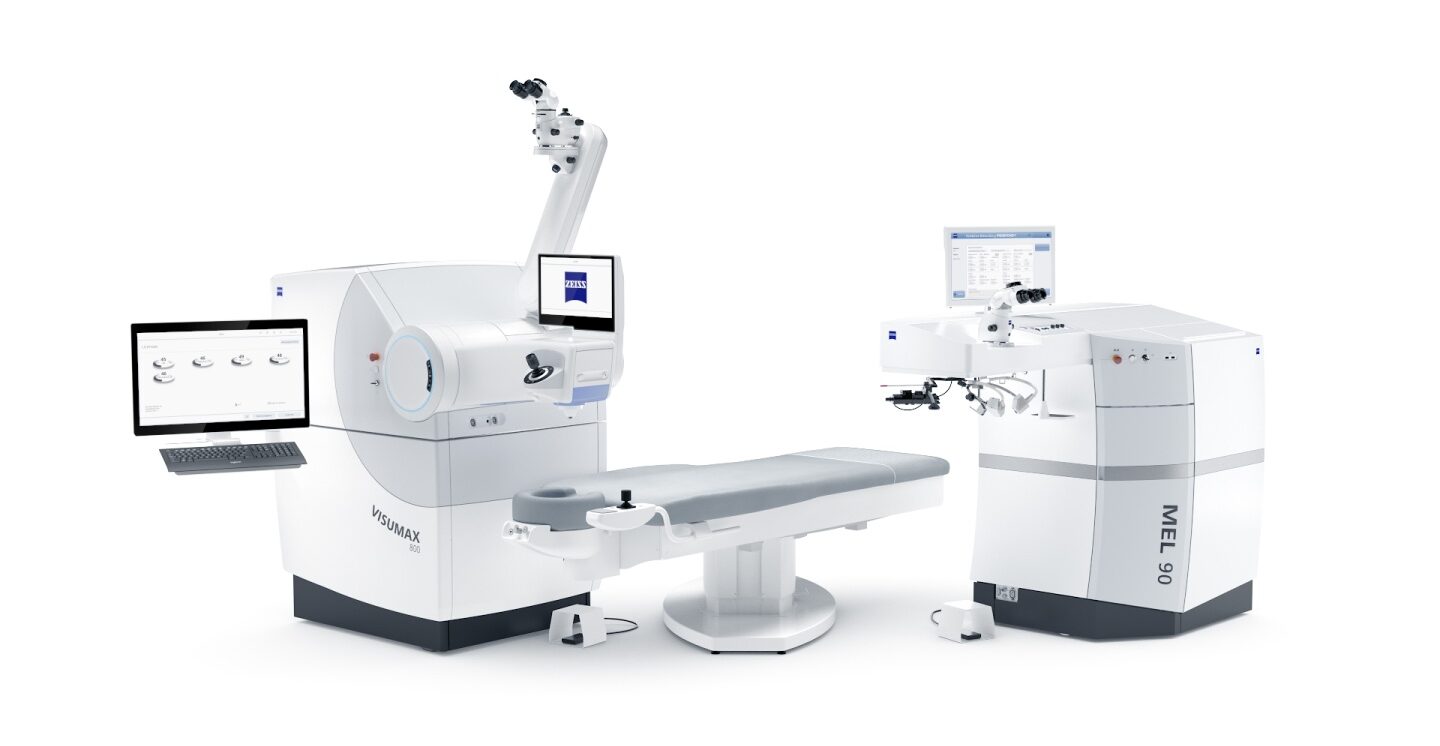
The procedure is similar to the Femto LASIK technique and is performed with 2 lasers. The first is the femtosecond laser which cuts a flap from the corneal thickness. After lifting this flap, the second laser reshapes the cornea in a personalized manner, corresponding to each eye's diopters. The procedure lasts about 5-10 minutes for each eye, of which the actual laser application time is under one minute.
At the end of the procedure, a therapeutic contact lens will be placed, which will be removed by the medical staff at the second-day check-up.
The procedure is performed on the same day for both eyes.
Presbyond Laser Blended Vision Technology
Laser surgeries are among the safest at present, and complications are extremely rare. However, there is no absolute guarantee regarding the result, efficacy, or safety of these procedures.
For treating presbyopia and other refractive errors, at Clario we use very high-performance refractive surgery lasers, produced by the German company Carl Zeiss Meditech: the Zeiss Visumax800 femtolaser and the Zeiss Mel90 excimer laser.
